


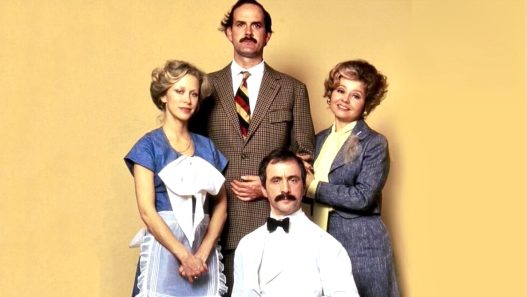


English comedy is everywhere. It powers everything from sketch shows to soap operas (well, OK, not dreary old EastEnders), chat shows to game shows. And its ubiquity is the reason why it’s the greatest, most developed, most nuanced on the planet. There are many reasons for this, but I’ll keep it brief.
You see, Little Britain and its rain-soaked natives has a rich, vibrant and often inexplicable sense of humour which uses comedy as its shield, its armour, their way of getting through the day until the Samaritans pick up the phone. In other words, the UK is an otherwise grey island beset with “the damp, the drizzle, the fog” forced to laugh at itself before the rest of the world does.
I mean, how else would you describe Liz Truss’ 49-day stint as Prime Minister for starters?
“He’s not absolutely positive . . . he’s almost got it. It’s lettuce and tomatoes, wal…”

My Serbian grandfather’s remarriage ceremony, Beaconsfield Old Town Registry Office, January 1990
Ploughing on from the first part of this prelude to the impending Perfect 10 of Fawlty Towers episodes, we find ourselves in the first months of the first year of the 1990s and the meandering green belt of Buckinghamshire where I spent my school and (first) college years.
Gorging on the six-hour banquet on those slightly battered ‘themed’ VHS tapes — we’d call it a binge watch now, right Gen Zs? — I couldn’t believe how hysterically funny Fawlty’s farce was. With non-chronological abandon, I lapped up every episode with relish, screaming with unfettered laughter while subtly chastising myself for being late to the party.
Me being me, I decided I now needed to know everything about this sitcom, and after chancing upon an archive book about the series in Milton Keynes Library I zoomed in on one surprising factoid: the opening and exterior scenes featuring that singular titular building had been shot in our very own county, Buckinghamshire’s Wooburn Grange Country Club, Bourne End.
The distinctive detached property, however, was only used for those specific outdoor links, as most interior footage was filmed some 23 miles away at BBC studio TC-8, within the iconic Television Centre HQ in Wood Lane, White City. Or Shepherd’s Bush if you’re not absolutely fabulous.
Talking of AbFab, it was also revealed in the ‘news’papers that the Pet Shop Boys’ favourite diva Dusty Springfield had recently curtailed her self-imposed overseas exile and re-settled in Bucks. Like yours truly, the former Maida Vale Mary was born in London but her formative years were spent in High Wycombe, where my uncle works, his having transferred from Eddy and Patsy’s ‘health’ resort du jour, Champneys.

SDP, Panos and Bruce in Kallithea, Chalkidiki, Greece, October 1990
By now it’s April 1990, and as I already had a lunch and movie date fixed for a spring Saturday afternoon in nearby Berkshire my cunning plan was to go south and multiply, literally. In other words, on the way to meet a Dundonian Caledonian called Bruce I planned quickly stalk Dusty’s new pad and then whizz around Wooburn.
The bucolic stockbroker belt parishes of Taplow and Bourne End are a mere 10 mins from each other, thus my dastardly plan was to double bubble this nosey visit in my shiny and new Sierra, the actual metallic silver model Ford its future owners ended up using as a motor sensational extra in the Pride miners movie, bizarrely. Are you still keeping up?
However, Bruce insisted I pick him up first over the Berkshire border in Maidenhead so we do the stalking together, which, coupled with the Saturday afternoon traffic — damned Waitrose wankers in their Cavaliers — made me annoyingly behind schedule. We’d pre-arranged to see The Hunt For Red October at the ABC cinema in Reading followed by an obligatory late lunch Pizza Hut combo, see, and so, as Bruce was a PSB fan — we did the Dusty, so to speak, and I reluctantly nixed the Fawlty pilgrimage, assuring myself I’ll do it another time. Have wheels will travel and all that, right?

Staying at the infamous Gleneagles in Torquay, April 2008. I even ordered kippers for breakfast (eww)
Except somehow I got sidetracked, and — boom — in March 1991, less than a year since I was mere minutes away, the sodding place went up in smoke, irreparably damaged by a mysterious fire.
Having lived in Bucks for 20 years it still niggles that I couldn’t pay pilgrimage to that instantly recognisable building. Not only had it become one of the most iconic locations in British comedy history but it was the bricks and mortar emblem of what had now become my favourite programme ever made. They’d apparently even renamed the bar Basil’s in tribute to the irascible hotelier. Though as parts of the structure dated rom the 1600s — the first Elizabethan age — National Heritage had listed the building, thus over time it’d had fallen into disrepair and had been unofficially taken over by hoodlums and money launderers.
Well, let’s just say fires aren’t always accidental. What’s the easiest way to make good your investment on a considerably large building the listing regulations forbid you from modernising? To quote belligerent Basil himself, “I don’t know why we don’t let you all burn.”
For many viewers, that isolated white and black-timbered building perched on that hill was Fawlty Towers. John Cleese and Connie Booth chose the location because it perfectly matched the slightly awkward, out-of-the-way feel of Basil Fawlty’s struggling hotel and it strongly resembles if not the actual inspiration for the series — that’s Gleneagles in the village of Wellswood, off the Lyme Bay bight of the Devon coast, of course — then it bears a remarkable resemblance to the OYO Sherwood Palm Hotel on the Torquay seafront. She said people use it in the lounge?

Oh, forgive me. I’m using present tense when I’m afraid I have to report that Gleneagles and the Sherwood have joined Wooburn at that great hotel inspectorate in the sky. The 41-bed sixties chalet styled Gleneagles shut its doors for the last time in 2015 and the land was redeveloped into a block of 33 retirement apartments.
While construction was underway our very own Spanish waiter Manuel, aka Andrew Sachs, fell victim to that celebrity holocaust of 2016 and, thus, once the building was completed in 2017 it was affectionately named Sachs Lodge. In recognition of its history, the site was even honoured with an official blue plaque ceremony by the Torbay Civic Society in 2018. I just pray the mayor wasn’t wearing a toupee.
In a remarkable case of inspiration following imitation, the Sherwood became something of a dodgy “anti-social behaviour magnet”. You can guess what happened next, can’t you? After a 2015 closure order by Devon authorities led to it becoming a derelict “eyesore”, in April 2026 the building was the target of arsonists, with a deliberate fffffffire causing a complete structural destruction. Oh great, three down, none to go.
As for Wooburn, the intimate housing development on that elevated cul-de-sac that replaced the ‘face of Fawlty’ consists eight attractive and rather expensive red-bricked houses cemented together in the traditional fashion. Nothing is left of the Country Club except for part of the driveway seen in the series which is now used as residents parking. It’s called Grange Drive but that’s the only titular throwback to its former life.
If we rewind a tad tangentially, in 2010 I found myself on a training course at the College of North West London with a Caroline Baxter who said she lived on Grange Drive. Seeing as in ’92 I’d buggered off from Bucks for the bright lights of the capital where I’d started this strange thing called life I was slightly marvelling at the proximity of my adolescent affection by proxy. But could I get her to snap a quick foot ‘felfie’ for me? Nope, and despite assuring me he would, neither did my distant cousin Chris Lancaster. And — get this — he lived and still works just minutes away from Wooburn and grew up in Torquay, I kid you not, as the son of a lovely lady called Marjorie who was my ancestry research go-to for a while.
Short of sending them some straw for their rooms I realised that old adage of “if you want something done do it yourself” is never truer than when the Fawlty Towers book of remembrance is involved, and so on a sleepy Sunday in September 2026 I found myself in merry olde Engerland, and — the weather was actually really rather nice. And so, after those couple of false starts I paid a Pafford pilgrimage to my old country and county.
Let’s not beat around the bird, I’ve much more photogenic feet anyway.

When Judi and I swapped medium Bucks for the big smoke, and upped sticks to London, the first house we rented a wee two-up two-down in W12, close to the future Old Oak Common superhub and Television Centre where not only FT had been recorded but also Aunty Beeb’s then new girl on the block, Absolutely Fabulous. Quelle surprise, world, because I’m an avid admirer/eternal quoter of AbFab too.
After she’d gone to Canada — to live, rather than look for the mysterious Elsie — my sister asked me “which do you think is funnier — Fawlty Towers or AbFab?” She had a slight preference for the latter, chiefly because Jennifer Saunders’ comedy speaks more to contemporary living and feels much more in tune with the torments and traits of 21st Century Britain.
Indeed, in terms of consistency Fawlty Towers is largely unmatched, but if I really had to choose I’d probably put several early AF episodes up to and including the first special The Last Shout slightly ahead of FT. Alas, the odd later scene excepted, Devon resident Saunders’ decision to revive the girls behaving badly antics of Eddy and Patsy in the 2000s seemed to delight in diluting its once peerless perfection.
One thing never changes, though, and that’s trend-chasing Edina Monsoon being pathologically obsessed with being “a very now person.” In that respect, although they are both irredeemably cruel and self-centred characters, Fawlty is Monsoon’s antithesis, a man not of his time and whose curmudgeonly contrariness sees that he makes no attempt to go fit in. You read a lot of Oscar Wilde, do you, John? Yes, I think he probably did, because if I pointed out that in fictional storytelling terms the names Basil and Sybil originated in a famous philosophical novel from 1890 you might you guess where I’m going with this.

Yes, it’s true John Cleese and collaborator-wife Connie Booth did have a flat on Basil Street in the late 60s and early 70s, No. 28, in fact, in the handsome Knightsbridge mansion block called Lincoln House, just behind Harrods. Monty Python was in part another Basil Street conception as the earliest meetings that led to the series were held there in May 1969; JC was also known to practise his Ministry Of Silly Walks in the corridor, leading to a neighbour questioning him about the “strange noises.”
It’s also true the Fawlty Towers name was a pun on the big hotel chain of the day, Trusthouse Forte, manacled together with a telling satire of ivory towers, ie the state of disconnection where the secluded are free to focus on lofty theories, artistic endeavours or elitist pursuits rather than involving themselves with the mundanities of everyday life. Basil to a tee then.
Yet there is a more literary explanation too. In the Victorian homoerotic horror The Picture Of Dorian Gray, Basil Hallward is a sexually repressed, staidly conventional intellectual hampered by the moral code of Victorian Britain, while Sibyl Vane (ho ho) is a less erudite but attractive actress woefully concerned with her appearance while going through the motions on a cheap stage, performing for the public.

The professions might have been altered (Basil’s art of painting would be taken over by put-upon Polly in Towers, probably because Cleese had already played Wilde’s contemporary James Abbott McNeill Whistler in Python’s Oscar Wilde Sketch) but transpose Wilde’s Basil and Sibyl to 70s Britain and it reinforces the view that Fawlty Towers was a deliberate pseudo period piece even then. I mean, wasn’t it already fairly obvious from the theme tune?
There may have been the briefest of mentions of the big four political figures of the day — Wilson, Thatcher, Franco and Kissinger — but take them away and Fawlty Towers could very easily be set in Victorian Britain. That’s because FT is an iteration of a comedy of manners. In other words, a satire on British societal pressures, and the class system, so brilliantly staged not only by Wilde but, by slightly later playwrights like the great wit Noël Coward as well.
You see, Basil is a crushing snob, hankering after a bygone era much of which occurred before he was even born, hence the toffy-nosed references to learned gentlemen such as Proust, Baden Powell, Earl Haig et al. Brahms and Chopin? They weren’t Brits but they were certainly composers of the Victorian era, and signify a double whammy as Cleese, like his greatest creation, is famously a bit crusty when it comes to his appreciation of music.
Case in point: JC’s two turns on Desert Island Discs reveal a posh playlist stuffed to his cummerbund with opera and orchestral works (slightly less highbrow there is Harry Nilsson too. Harry Nilsson as well, you scabby old battleaxe) — most notably, a Mascagni masterpiece which translates as Rustic Chivalry, a classic verismo Basil extols in Communication Problems.
“Do you like Cavalleria Rusticana, Terry?”
“I’ve never had it, Mr Fawlty.”
Jolly Basil then tells Sybil that he “can’t stand Frank Sinatra.” I don’t know if that’s Cleese’s personal preferences creeping in again, but he did end up voicing a version of My Way, however sardonically, in the Disney caper George Of The Jungle 2… as an ape. Oh, Mr Johnson will be laughing into his fertility medallion at that one.

Making all of us feel so much younger, Cleese is something of a Streisand superfan so my guess is he’d be partial to Sinatra too. Curiously, most of the Pythons weren’t huge fans of rock and pop, particularly after the 60s. When Eric Idle proudly boasted “I never listened to any group after 1970” I imagine the rest of them were nodding in agreement.
All six of the Circus team were born way before my parents, so generational divides play their part once again. But I guess the thing that really piqued my interest was that I’d heard an interview where Terry Jones outed Cleese as having an inexplicable hatred of Marc Bolan and would fly into a uncontrollable rage whenever a T. Rex tune wafted over there airwaves in the early 70s.
When I was one of the staffers at the MOJO magazine in the early 2000s I suggested to the editor this titbit might be a way to angle an interview request with JC. Alas, not about acting but purely his music preferences, where I’d planned to tackle the tall one about his Bolan bitterness. His manager said he was up for it too, though in the end he was forced to scotch the idea when the Pythons reunited for some cash grab live appearances. Alimony, alimony? They’ve all got it in for the lover of the American blonde, haven’t they?
Well, get me. Because I had already met Cleese — and Idle — at the Leicester Square premiere of the latter’s star vehicle Splitting Heirs in 1993. Despite having ditched the moustache, Cleese was slightly more like Basil than I was expecting: he was perfectly civil but his body language gave the game pie away: pleasantly aloof and a bit starchy in his crease-free tux, with an oversized head sporting a very showbiz smile enacted through slightly gritted teeth. Pah, what did I care when my night’s proudest moment was telling Piers Morgan to his face “You’re a wanker”. Funnily enough, he still is.
However, that was small fry compared to meeting the screen missus round the corner at my birthplace, Covent Garden, the following year. Just prior to filming the BBC drama Breaking The Code, where she played Ethel Sara, the Sorbonne student mother of my and now everyone’s favourite Bletchley icon, doctor of mathematics and father of the computer Alan Turing.

Prunella Scales — for it is she — was attending the opening of The Actors Centre in Seven Dials. I’m happy to say I got on famously with the likes of Anthony Hopkins (impeccably gracious) and Ian McKellen (flirty as fuck), but when it came to the formidable female who played Sybil, the champagne Gandalf plied me with must have gone straight to my head. And though it didn’t come away, I couldn’t think of anything interesting to say to her except for “When are they going to repeat Fawlty Towers on the BBC?”
I know right, utterly lame. Especially as I know all too well how irksome it must be when a six-hour series from way back representing a tiny fraction of a long and distinguished career is all anyone wants to talk to you about. In my defence it’s perfectly Sybil, I was a rather geeky 25, hardly a wizened veteran like the Major, old boy. What was the question again?
Pru fixed me a steely glare and exclaimed, incredulously and very loudly, “You can buy the bloody videos!” Suddenly the temperature was colder than Debbie Harry’s ice cream and nowhere near as sweet. She don’t say! Just like Sybil, it was hard not to wonder if her specialist subject really was the bleeding obvious.
Suitably chastened, I took a discreet step back and noticed a marginally taller attractive brunette with battle-worn crow’s feet. She was standing to the left of the scolding Scales trying very hard not to laugh. Crikey, if it’s not Mary Tamm! She was in royalties heaven at the time, as many of us, including this on-off lapsed Whovian, had been transported, Tardis-like back to the 70s via UK Gold’s Sunday morning reruns of Doctor Who, where she played the Time Lady Romana opposite the indomitable Tom Baker.
How to deal with the vituperative nest of vipers in 1994 though? Me being me, my inbuilt instinct is to pounce with a pithy comeback. Or perhaps I should make her feel sorry for me by suggesting that perhaps I couldn’t afford to buy the bloody videos because I was either a) unemployed b) a student or c) deaf, mad and blind.

Being firmly on the spectrum, doing the telling lies thing can be a trial, but then I remembered that not only did I still possess those VHS sets I’d conveniently forgot to return to my old employers in Bucks but that my current workplace — but what would turn out to be my very last chef’s job in the UK — was at Queen Charlotte’s, a West London maternity hospital on the edge of Hammersmith and Chiswick where Prunella had given birth to fellow thespian Samuel West.
Tsk, I could have avoided the little piranha fish’s belittling and engaged her in chatter about epidurals and effleurage if I’d been more on the ball. But by this point I dared not to care, and, happily, neither did my little Kommandant as she tottered off to gossip with Carry On star Fenella Fielding in a most unbecoming nylon wig (Fen not Pro).
That was the other thing I couldn’t fail to notice, in fact, as our Syb was incredibly small. Mrs West was roughly the same height as the even more piranha-like Madonna, but shorter than Thatcher and Queen Elizabeth II, whom she ended up playing. In fact, it struck me how Scales’s clipped accent was almost as upper crust as our dear housewife superstar monarch.

“She makes the Queen sound like a slut” was in fact one of the more forthright assessments of Pru’s performance as QE2 in Alan Bennett’s A Question Of Attribution. Indeed, I had her pegged as vaguely upper middle class, whereas Cleese in the flesh I found to be very middling middle. In other words, the pair engineered a slight accent swap for filming the Fawltys, with Basil coming on a bit posher than John and Sybil something of a lower middle class fishwife.
Or was it that Barcelona birdbrain Manuel? I can never remember. However, you’ll be pleased to know that, like James Bond, my memory will return. And hopefully in time for stevepafford.com’s long-gestating Perfect 10 of Fawlty Towers episodes, too. Because I’ll be joined by a cheeky chunk of the Cleese commentariat on three continents and we assess which stories make the strongest case for the show — the obvious classics, and which are rated B-listers, the ones that tend to get overlooked because everyone keeps talking about the Germans.
Oh, sorry.
Come back soon where we’ll have a veally good clutch of reviews for you proles, including Catherine Walters touching her Class in England, Paul Evans blowing up a Corpse in Wales, Daniel Ruggero fancying a dirty Rat in Australia, and Kevin Riggs in dire need of a Psychiatrist in Mexico.
He is, really. Did you see Annie Hall?
Steve Pafford
RIPPS


