


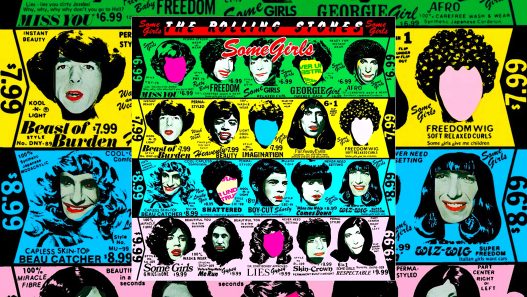



Published on 4 September 2025, Record Collector Presents… Rolling Stones Vol 2: Domination 1970-79) is a 116-page special edition magazine dedicated to the second, post-Decca, post-Brian Jones era of the world’s greatest rock ’n roll band, from Sticky Fingers to Some Girls. And as we must all know by now, Bill’s thrilled, he loves huge openings.
With passion aforethought, the mononym mag’s fabulously conscientious editor Charles Donovan kindly commissioned a pair of lengthy pieces from yours truly. As this week also happens to mark the 70th anniversary of the UK’s first official album chart it seems doubly appropriate to bring to you a slightly exclusive unedited edition of the other LP-focused piece (the first being a recent Exile at Nellcote eyewitness account from the French Riviera).
In this relentlessly sizzling summer of ’26 it feels like you can’t move for the celebration of the old boys’ 65th year in Ver Biz. The main members have certainly been pushed headlong on the promotional treadmill, with myriad interviews certainly entertaining if not actually revealing very much other than Robert Smith (from The Cure) and Paul McCartney (from The Beatles) guest on different tunes, Amy Winehouse is covered, and Mick Jagger doesn’t like getting old. Oh, and in sparring mode, my erstwhile Richmond Hill neighbour reckons John Lennon and his old Dancing In the Street duetting dame David Bowie were “so competitive. I was made competitive by David.” Hmmm.

There is an ironic incongruity in this week’s twin chart news, by the way. With their latest studio set having just steamed straight in to the top spot, the Stones have, as expected, kicked Madonna and her Xerox disco fluff off of a solitary one-week squat at No.1 to give them their fifteenth long-playing chart-topper with Foreign Tongues. That feat ties them to joint silver position with erstwhile rivals The Beatles while the gold top gong is inexplicably occupied by Blobbie Williams on an unsweet 16.
As the late Bonnie Tyler would have warbled, that’s a rockin’ good way to mark seven decades of chart history. Yet in many ways the most disconcerting countdown of all is that the Official Charts Company also revealed the 70 biggest albums of the last 70 years.
No biggie, right? Except that nestled among the ubiquitous and the contemptuous are a smattering of of-the-moment almost-forgotten behemoths: come on down the Corrs, the evil Dido, Alanis Morrisdancer, Snorah Jones and Shania Vain. I have to admit I’m not an absolute shit because I don’t have anything hugely against any of those mediocre must-plays from that strange fin de siècle era.
No, it’s more the slightly astonishing realisation that they’ve singularly shifted more than units than anything by multi-decade charting industry heavyweights like (deep breath) Elvis Presley, Bob Dylan and the pottily prolific Elton John.
Even veteran platinum shifters Genesis, Led Zeppelin, The Eagles and The Police are conspicuous by their wholesale absence. While being officially the biggest selling American band in the history of the UK charts doesn’t seem to be counting for much over at Team Blondie right now.
And, yup, you guessed it, The Rolling Who, sorry I mean Stones, didn’t make the grade either. Nor — shock, horror, did the Space Oddity himself, Mr Bowie.

This is where I’m tempted to say there really is no accounting for taste, except as I write this I’ve just realised there’s not a sniff of Whitney, Céline or Vylie either. Perhaps there is a god after all. More tea, Vicar?
So it just remains for me to point out that if you think Jagger and co’s albums are a veritable smorgasbord of under-achievers and blink-and-you’ll-miss-them quick-fire musical bullets then spare a thought for the following female-fronted oeuvres.
None of them set the charts ablaze but the sassy soul sisters who helped power two of the most celebrated Stones sets to a higher plane had rather a lot more going for them than, say, Guns N’ fucking Roses (67th place), Travis (58), or pop’s posterior pustules, that pair of whiny bedwetting bores Sam bloody Smith (32) and James Blunt (26). Or something that rhymes with Blunt.
Enjoy the article.
STONED SOUL PICNIC
At the turn of the decade, The Rolling Stones expanded their sonic tapestry and recruited some of America’s most talented session singers for Let It Bleed and Exile On Main St., all of whom went on to great things in the 1970s, says STEVE PAFFORD.
Stones and women. They go together like ham and cheese, or caviar and champagne if the budget allows. But who were the fabulous funky femmes whose sass and soul not only helped power some of the band’s most visceral tunes, but, happily, also received career boosts because of the association?
Sit back as RC spins the 70s solo sets made by Some Girls who backed Mick and the boys on two of their greatest albums. Operators are standing by.
MERRY CLAYTON (LET IT BLEED)

Late one night in the winter of ’69, Merry Clayton arrived at a Los Angeles studio in rollers, pyjamas and sporting a four-month pregnancy bump, having been co-opted into guesting on Gimme Shelter, with memorable results (for her sterling efforts, she was credited rather dismissively as “Mary” on the album jacket).
New Orleans’ Merry Clayton was so-named because she born on Christmas Day (the same 1948 month as my mother, though only one of them is a soul and gospel singer). After the Stones session, Merry recorded her own impassioned rejig of Gimme Shelter on her 1970 album of the same name (Ode/A&M AMLS 995, UK, £80), which would act as her solo debut and the first of three LPs for Lou Adler’s Ode Records in the firsthalf of the decade.
Following swiftly in ’71, her fizzing eponymous set (Ode/A&M AMLS 67012, UK, £45) was a much better showcase for her pealing vocal flips. Coruscating covers of Neil Young’s Southern Man and Carole King’s After All This Time are worth their weight in goldrush, proving she had the pipes to rival Aretha Franklin in range if not stature.
A funkier third from ’75, Keep Your Eye On The Sparrow (Ode SP 77030, US, £25), contains another Southern soul jewel in the shape of Bill Hayes’ Room 205, as well as the TV tie-in title track aka Baretta’s Theme, recorded by myriad artists though Clayton’s was the first to chart. Clayton was also the featured vocalist on Lynyrd Skynyrd’s ‘controversial’ Sweet Home Alabama, where she joined her pal Clydie. Talking of whom…
CLYDIE KING (EXILE ON MAIN ST.)

“My ultimate singing partner,” was how none other than Bob Dylan described our next diva. As was Clayton, Clydie King was a member of the Raelettes – Ray Charles’ backing group – going on to contribute vocals to a quartet of Exile cuts: Tumbling Dice, I Just Want To See His Face, Let It Loose and Shine A Light.
Her voice was more honeyed, like a coquettish cross between Diana Ross and Minnie Riperton. Direct Me (Lizard A 20104, US, 1970, £13), her debut, is a ragbag of funk, covers and balladeering, and boasts a scratchy take on The Beatles’ Long And Winding Road just months after the original. It didn’t do much, though ’Bout Love picked up minor spins on the UK’s Northern soul scene, and there’s an adequate take of The Mirettes’ Ain’t My Stuff Good Enough.
A year later CK nicked the Brown Sugar name (but not the song itself) for her second set, clumsily titled Brown Sugar Featuring Clydie King (Chelsea BCL 10368, US, 1973, £5), produced by George Tobin, arranged by Jimmie Haskell and starring the combined vocal talents of King with Allison Hobbs and Phyllis ‘Move Closer’ Nelson. The horn-fuelled Loneliness is the supreme song here, while the better produced Rushing To Meet You (Tiger Lily TL 14037, US, 1976, £350) is a lush, more resolutely funk-soul sister with a whiff of a disco-flavoured deliciousness.
VENETTA FIELDS (EXILE ON MAIN ST.)

Venetta Fields was a member of the aforementioned Mirettes (a vocal trio comprising ex-Ikettes) and featured on Exile in 1972, reluctantly agreeing to the midnight sessions because she wanted the money to buy clothes: “I was more interested in the coat than I was in The Rolling Stones,” she quipped.
First released on the Grit imprint in 1976, The Dupars featuring Vanetta (sic) Fields’ Love Cookin’ We Rockin’ (Grit G 2004, US, £80) was long forgotten until a 2004 reissue returned it to the funk-sphere. With Fields coming on like the estranged sibling of Betty Davis fronting the Family Stone, the album’s airtight grooves and 70s disco danceability collide with an intriguing melange taking in Latin, novelty spunk, and raw funk.
The set is best exemplified by its opening salvo: the pseudo title-track is psychedelic and mellow while I Wanna Dance is like a blast of pure ecstasy, its tight fluid horn lines underpinning a strange yet resolutely ’76 fusion. Indeed, in a way it sounds like Stevie Wonder’s chanced upon an advance copy of Bowie’s Low and decided to make a soft porn soundtrack with one of Eno’s synthy backing tracks.
KATHI MCDONALD (EXILE ON MAIN ST.)

Now this is a lady could sing her ass off. Hailing from a remote island near the Canadian border, Kathi McDonald made her way to San Francisco from the Pacific Northwest as a pregnant 19 year-old, and soon found herself in a recording studio joining Ike & Tina Turner as only the second white singer in the Ikettes, Man Tan make-up an’ all.
After replacing her spiritual twin Janis Joplin in that ever-evolving troupe of soul power Big Brother And The Holding Company, Kathi collided with the Stones for Exile’s LA sessions, pouring her gutsy blues into tracks such as Tumbling Dice and, most notably, All Down The Line.
Though primarily a backing vocalist, Kathi had the pipes, the moves, and the whole nine yards so producer David Briggs (my mother’s cousin, no less) masterminded a debut album issued by the Capitol label in 1974.
Boasting a who’s who of musicians including Aynsley Dunbar, Nils Lofgren, and The Pointer Sisters curiously switching roles with the upgraded McDonald, Insane Asylum (Capitol ST 11224, US, £18) took its title from a rootsy Willie Dixon rework that closes out the set as an incendiary duet with Sly Stone himself. On this tale of terror and torpor, the pair trade lines and scat infectiously off each as the album reaches its climactic apogee.
Also of note is the record’s opener and only self-penned song, a scene-setting slice of living nostalgia called Bogart To Bowie, co-written with another Bromley boy, Pete Sears. It’s not the best cut here, though with its of-the-moment rock opera leanings and quoting of the piano-and- guitar morse-code section of Starman, you could almost imagine it as a long-lost leftover from the Thin White Dame’s aborted Ziggy musical from the same period.
TAMI LYNN (EXILE ON MAIN ST.)

Another renowned chorister from New Orleans (does Louisiana put something in the water?), Tami Lynn went to school with Allen Toussaint and Ellis Marsalis, was an opening act for Miles Davis and Ella Fitzgerald, and go-to vocalist for Sam Cooke and Dr John. You’d think with that American pedigree a successful recording career of her own was a mere formality.
Yet it took a years-old single, I’m Gonna Run Away From You, to take off across the pond to get things going. An Atlantic soul classic turned Northern soul staple, in musical and lyrical terms the 45 was something of a sonic twin of Gloria Jones’ Tainted Love. Indeed, it was devotees of the Wigan Casino-led sub-genre who took it to UK No 4 in June 1971 (forgive the odd gonzo interjection, but the date happened to be my second birthday, with Tami passing, freakily, on my 51st in 2020).
The song’s belated success bagged Tami an invite to emote on Exile, which pleased the happy Anglophile no end (“I spent a full day and night working with Micky and Keith. Let It Loose is one fine song. I really enjoyed that one.”) That led to her sole solo set, Love Is Here And Now You’re Gone (Cotillion/Mojo 2916007, UK, 1972, £15). The first side was a song-suite telling the story of a love affair in pseudo-Southern Gothic stylee, featuring a faithful rework of The Supremes’ title track, while a Memphis horn-fuelled of an old Motown curio called Mojo Hannah is a blistering slice of badass funk re-upholstered for the gumbo generation.
Tuning into Tamla once more, there’s also a remake of Loretta Lynn’s killer country ballad Wings Upon Your Horn done as an affecting Gladys Knight-esque gospel-flecked weepie. It really deserves some long overdue recognition. Much like Lynn herself.
SHIRLEY GOODMAN (EXILE ON MAIN ST.)

Surely Shirley needs no introduction. A New Orleans native, Goodman was the head of 1950s R&B duo, Shirley & Lee, who wanted to Let The Good Times Roll, and in the 1970s fronted the eight-member Shirley & Company. Famous for the bubblegum banger Shame, Shame, Shame, it’s been covered by everyone from GoldenEye’s theme singer Tina Turner and its Bond girl Izabella Scorupco to, er, Sinitta and the Stones themselves, via a spirited and recently unearthed outtake which originates from 1976’s Black And Blue sessions.
A perfect example of a Happy/Sad contrast which happens to reference the Watergate affair, the Shame song was written and produced by another 50s rock’n’roller, Sylvia ‘Love Is Strange’ Robinson. It’s said to have galvanised the Glimmer Twins into penning Hot Stuff, too — which makes perfect sense seeing as the Stones had already made use of Goodman’s tough and testy soprano on Exile’s Let it Loose.
With its sassy, sonorous bassline and Bo Diddley beat, the single was one of the earliest examples of that thing called an international disco smash, so much so that Shirley’s label ordered a full-length LP of the same name (Vibration VI 128, US, £8) in 1975. For those not needing a whitewash, the political overtones of Shame are made crystal clear on the album cover, which depicts Goodman angrily wagging a finger at a cartoon Richard Nixon.
Shirley was at heart a creamy blues shouter cum-soul survivor, though she glides though these frothier offerings with admirable aplomb. Much of the material is like its title track – light, playful dance pop but with an exuberant and soulful grasp. The overall vibe is almost that of a ska or rocksteady record, and, appropriately, there are “versions” and reprises throughout.
No matter, because the whole shebang is a riot of riffs and sassy self-referencing. Case in point: Cry, Cry, Cry and Disco Shirley, both rejigs of the initial hit, were issued as follow-up 45s which didn’t do anything like as well.
Now that is a shame.
Steve Pafford
https://recordcollectormag.com/rc-specials/record-collector-presents-rolling-stones-in-the-1970s


